
SKU : GC303011-100mg
หมวดหมู่ : Biochemicals , 1. Chemical and Reagents , Buffers , Servicebio ,
แบรนด์ : Servicebio
Share
Product Information
Product Name | Cat. No. | Spec. |
NADPH-Na4 | GC303011-100mg | 100 mg |
Introduction
NADPH, or reduced coenzyme II, scientifically known as reduced nicotinamide adenine dinucleotide phosphate, is a coenzyme in which N refers to nicotinamide, A to adenine, D to dinucleotide, and P to the phosphate group.
NADPH is important for its role as a hydrogen transporter in many chemical reactions in living organisms. It is aphosphorylated derivative of the 2'-position of the ribose ring system linked to adenine innicotinamide adenine dinucleotide (NAD+), and participates in a variety of anabolic reactions, such as synthesis of lipids, fatty acids, and nucleotides, and also supplies energy for carbon dioxide fixation in dark reactions. These reactions require NADPH as a reducing agent, a donor of hydrogen negative ions, and NADPH isthe reduced form of NADP+.
Basic Attributes
Name | NADPH-Na4 |
Synonym | Reducing coenzyme tetrasodium salt,phosphate tetrasodium;Coenzymereduced form tetrasodium salt;Dihydronicotinamide ademine dinucleotide;NADPH2-Na4;TPNH2-Na4 |
CAS | 2646-71-1 |
Molecular formula | C21H26N7O17P3·4Na |
Molecular mass | 833.4 |
Purity | 90% |
Appearance (character) | White to light yellow solid |
Storage conditions | -20 |
Unit | Bottle |
Spec. | 100 mg |
Pubchem CID | 15983949 |
MDL No. | MFCD00036263 |
EC No. | 220-163-3 |
Related categories | Vitamin |
Solubility | Soluble in water (50 mg/ml).10 mM NaOH: soluble 50 mg/mL, clear |
Validity | 24 months |
Molecular Structural
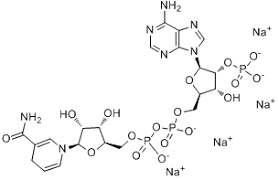
Instructions
The usage and dosage of biochemical reagents are mainly determined according to the customer's experimental purpose and the experimental methods in existing literature or books. The following uses are for reference only.
NADPH as a hydrogen donor can participate in a variety of metabolic reactions in the body:
1) NADPH is a hydrogen donor for many anabolisms in the body, including the biosynthesis of dihydrofolate, tetrahydrofolate, L-malate to pyruvate, heme to bilirubin, the monooxygenase enzyme system, sphingomyelin, cholesterol, fatty acids, corticosteroids, and sex hormones;
2) NADPH+H* is involved in hydroxylation reactions in the body and in the biotransformation of drugs, toxins, and certain hormones;
3) NADPH is used to maintain the reduced state of glutathione (GSH) and, as a coenzyme of GSH reductase, plays an important role in maintaining the amount of reduced GSH in cells.
In plant chloroplasts, the final step in the electron chain of the photosynthesis light reaction is based on NADP+, which is catalyzed by the enzyme ferredoxin-NADP+ reductase to produce NADPH. the NADPH produced is next used for the assimilation of carbon dioxide in the dark reaction.
For animals, the oxidized phase of the pentose phosphate pathway is the main source of NADPH in the cell, from which 60% of the required NADPH (also known as [H]) is produced.
Note
The [H] in photosynthesis is NADPH; the [H] in respiration is not NADPH but NADH andFADH2; [H] includes the different types of reduced state hydrogen produced in photosynthesis and respiration, so [H] cannot simply be considered equivalent to NADPH.Of course, despite the different types of [H] and their different targets (NADPH targets three-carbon compounds, generally written asC3, and NADH andFADH2targetO2), they all belong to strongly reducing substances, and from this point of view they can be collectively referred to as [H].
Security Information
WGK | 3 |
Note: The product may be optimized and upgraded. The actual label information prevails.
For Research Use Only! Not for use in diagnostic procedures!


