


Products
Protein Biology Reagents | Consumables
Protein Purification
Protease
SKU : G3411-2000U
หมวดหมู่ : Biochemicals , 1. Chemical and Reagents , Buffers , Servicebio ,
แบรนด์ : Servicebio
Share
Product Information
Product Name | Cat. No. | Spec. |
Recombinant SUMO Protease (Ulp1, His-tag) | G3411-2000U | 2000 U |
Product Description/Introduction
Recombinant SUMO Protease is a highly active cysteinyl protease also known as Ulp1 (ubiquitin-like protein-specific protease 1).SUMO Protease cleaves in a highly specific manner, recognizing the tertiary structure of the ubiquitin-like (UBL) protein, SUMO rather than an amino acid sequence. The optimal temperature for cleavage is 30°C; however, the enzyme is active over wide ranges of temperature (2-30) and pH (pH 6.010.0). In the actual operation, in order to preserve the structure and biological activity of the target protein, it is recommended to use Recombinant SUMO Protease at 4 overnight. At the same time, adding appropriate concentration of DTT (0.5-2 mM) in the digestion system can also significantly improve the digestion efficiency.SUMO Protease, a highly active cysteinyl protease also known as Ulp, is a recombinant fragment of Ulp1 (Ubl-specific protease 1) from Saccharomyces cerevisiae. SUMO Protease cleaves in a highly specific manner, recognizing the tertiary structure of the ubiquitin-like (UBL) protein, SUMO rather than an amino acid sequence. The protease can be used to cleave SUMO from recombinant fusion proteins. The optimal temperature for cleavage is 30°C; however, the enzyme is active over wide ranges of temperature (2-30) and pH (pH 6.010.0). Following digestion, SUMO Protease is easily removed from the cleavage reaction by affinity chromatography using the polyhistidine tag at the N-terminus of the protease.
Application: The Protease can be used to cleave SUMO from recombinant fusion proteins.
Source: Saccharomyces cerevisiae cysteine protease, It is purified from E. coli by affinity chromatography using the polyhistidine tag.
Enzyme activity: One unit of SUMO Protease cleaves 85% of 2µg control substrate in 1h at 30 and pH 8.0.
Inactivation or inhibition: Concentrations of the imidazole higher than 150 mM can adversely affect the activity of the protease.
Purity and concentration: Purity 95% by SDS-PAGE, 10 U/μL.
Recombinant SUMO protease storage solution:25 mM Tris-HCl,pH 8.0,0.1% NP-40,250 mM NaCl,500 μM DTT,50% (v/v) glycerol.
10×SUMO Buffer+Salt:500 mM Tris-HCl,pH 8.0,2% NP-40,1.5 M NaCl,10 mM DTT.
10×SUMO Buffer - Salt:500 mM Tris-HCl,pH 8.0,2% NP-40,10 mM DTT.
Storage and Shipping Conditions
Ship with wet ice; Store at -20; Valid for 12 months.
Product Components
Component Number | Component | G3411-2000U |
G3411-1 | Recombinant SUMO Protease (His-tag) (10 U/μL) | 200 μL |
G3411-2 | 10×SUMO Buffer + Salt | 1 mL |
G3411-3 | 10×SUMO Buffer - Salt | 1 mL |
G3411-4 | Control Protein | 100 μL |
Manual | ||
Assay Protocol/Procedures
1. Protease digestion system recommended:
Component | Volume |
10×SUMO Buffer +/- Salt | 5 μL |
Target Proteins | 20 μg |
Recombinant SUMO Protease (His-tag) (10 U/μL) | 1 μL |
ddH2O | To 50 μL |
Note: For most fusion proteins, SUMO Protease functions optimally in a reaction mixture containing 150 mM NaCl; however,conditions may be optimized by varying the NaCl concentration from 0 mM to 300 mM.
2. Place at 30 for 1, 2 or 4 h. It can also digest at 4 overnight (about 16 h) if the target protein is not stable at 30.;
3. Remove 10 μL enzyme digestion product, for SDS-PAGE electrophoresis to evaluate the amount of enzyme digestion and reaction conditions.
Note
1. Place in an ice box or ice bath when used, and separately store at -20 immediately after use.
2. For your safety and health, please wear safety glasses, gloves, or protective clothing.
Examples of enzyme digestion applications
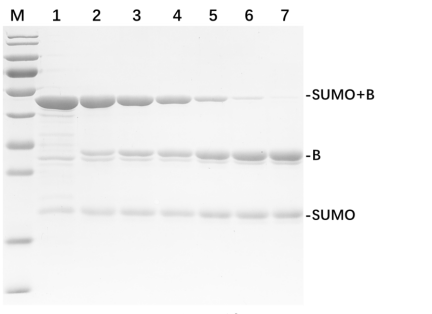
Figure 1: Effect of recombinant SUMO Protease digestion of control substrate protein (SUMO+B fusion protein) (The enzyme digestion conditions are 30 and pH 8.0, respectively for 0 min, 10 min, 20 min, 30 min, 1 h, 2 h and 4 h, corresponding to Lane 1-7 in turn, and the mass ratio of substrate and enzyme addin the enzyme digestion system is 10:1)
For Research Use Only!


