
SKU : GC303014-250mg
หมวดหมู่ : Biochemicals , 1. Chemical and Reagents , Buffers , Servicebio ,
แบรนด์ : Servicebio
Share
Product Information
Product Name | Cat. No. | Spec. |
NADH Na2 | GC303014-250mg | 250 mg |
Introduction
Reduced coenzyme I (NADH), also known as reduced β-nicotinamide adenine dinucleotide (reduced), is a coenzyme involved in glycolysis, β-oxidation, and the citric acid cycle (Krebs cycle, TCA cycle) in the catabolic process, used as a regenerative electron donor. It is also involved in cellular signaling events, such as serving as a substrate for polyADP-ribose polymerases (PARPs) in response to DNA damage. The NAD+/ NADH-dependent Sirtuins family proteins play a key role in the stress response to many physiological events involved in energy metabolism (implicated in tumor biology, diabetes, and neurodegenerative diseases). NADH Can also be used in enzyme cycling experiments to amplify the activity of related enzymes or to increase the content of low-concentration metabolites.
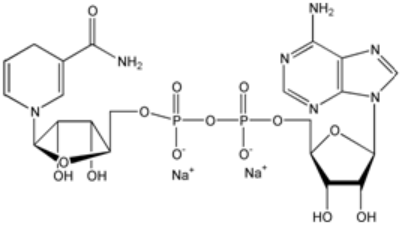
This product is a reduced Coenzyme I (NADH-NA2) in the form of disodium salt.
Basic Attributes
Name | NADH Na2 |
Synonym | Reduction β- Nicotinamide adenine dinucleotide disodium salt; β- Reducing the disodium salt of coenzyme I; Dihydrodophosphopyridinenucleotide disodium salt; Reduced coenzymesodium salt; NADH-Na2; Reduced nicotinamide adenine dinucleotide disodium salt |
CAS | 606-68-8 |
Molecular formula | C21H27N7Na2O14P2 |
Molecular mass | 709.4 |
Purity | 98% |
Appearance (character) | Yellow powder |
Storage conditions | -20 |
Unit | Bottle |
Spec. | 250 mg |
Pubchem CID | 2724710 |
MDL No. | MFCD00036200 |
EC No. | 210-123-3 |
Related categories | Vitamins |
Solubility | 50 mg/ ml Water |
Molecular Structural
Instructions
NADH is mainly involved in the metabolism of substances and energy in cells. It is generated in the citric acid cycle of glycolysis and cellular respiration. As the carrier and electron donor of biological hydrogen, NADH transfers energy to ATP synthesis in the inner mitochondrial membrane through the process of oxidative phosphorylation, so NADH is also called mitotin. In theory, for every molecule of NADH, you can make three molecules of ATP.
NADH plays an important role in maintaining cell growth, differentiation and energy metabolism, as well as in cell protection.
NADH is produced by the citric acid cycle in glycolysis and cellular respiration. The NADH molecule is a control marker in the energy-producing chain in mitochondria. Monitoring the REDOX status of NADH is the best parameter to characterize mitochondrial function in vivo. Ultraviolet light can excite NADH in mitochondria to produce fluorescence, which is used to monitor mitochondrial function.
Note:
1)It is not recommended to prepare the solution directly with aqueous solution, because it is likely to be acidic and cause NADH degradation.
2)If the solution must be stored for a period of time, avoid phosphoric acid buffer, which can accelerate NADH degradation. Trizma (0.01M, pH 8.5) and MES buffer are the best choice. NADH solutions are readily oxidized even at very low temperatures, so the prepared solution must be at a concentration 5mM, pH 9-11, and stored at 4 ° c. Light and heavy metals speed up the oxidation process. Lower storage temperature is allowed (-40), higher concentration of solution can be prepared, can prolong the storage period.
3)For your safety and health, please wear a lab coat and disposable gloves.
Security Information
WGK | 3 |
Note: The product may be optimized and upgraded. The actual label information prevails.
For Research Use Only!


