
SKU : GC307020-5g
หมวดหมู่ : Biochemicals , 1. Chemical and Reagents , Buffers , Servicebio ,
แบรนด์ : Servicebio
Share
Product Information
Product Name | Cat. No. | Spec. |
Hematoxylin | GC307020-5g | 5 g |
Introduction
Hematoxylin is a basic dye extracted from the heartwood of Hematoxylinaceae, which is the most widely used dye in plant tissue preparation. When used with mordants (usually trivalent iron or aluminum salts), nucleus can be dyed. Neither hematoxylin nor oxidized hematoxylin has the ability to dye, but can form lakes when combined with mordants. This lake has the ability to stain, and the nucleus, chromosome, centromere, centrosome, mitochondria, myelin, etc. can be stained blue or black. Hematoxylin-eosin double staining is the most basic general tissue staining method. The nucleus appears blue and the cytoplasm appears pink or red.
Basic Attributes
Name | Hematoxylin |
Synonym | Hematoxylin |
CAS | 517-28-2 |
Molecular formula | C16H14O6·3H2O |
Molecular mass | 356.33 |
Purity | Biotechnology |
Appearance (character) | Light brown or yellowish brown powder |
Storage conditions | Room temperature |
Unit | Bottle |
Spec. | 5 g |
Pubchem CID | 0 |
MDL No. | MFCD00005394 |
EC No. | 208-237-3 |
Related categories | Biochemical reagent, biological pigment |
Solubility | Soluble in water |
Validity | 36 months |
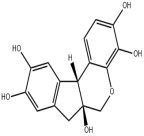
Molecular Structural
Storage and Handling Conditions
Store at room temperature.
Instructions
The usage and dosage of biochemical reagents are mainly determined according to the customer's experimental purpose and the experimental methods in existing literature or books. The following uses are for reference only.
The preparation method of hematoxylin staining solution:
(1) Harry's hematoxylin: 1g hematoxylin; 10ml anhydrous alcohol; 20g aluminum potassium sulfate; 200ml distilled water; 0.5g mercuric oxide; 8ml glacial acetic acid.
Dissolve hematoxylin with anhydrous alcohol, heat and dissolve potassium aluminum sulfate in distilled water, then mix and boil the two liquids, add mercuric oxide, continue to heat and stir until the solution is dark purple, cool immediately, return to room temperature and filter for use.
(2) Modified Lillie-Mayer's hematoxylin: hematoxylin 2.5g; anhydrous alcohol 20ml; aluminum potassium sulfate 5g; distilled water 330ml; sodium iodate 250mg; glycerol 150ml; glacial acetic acid 10ml.
Dissolve hematoxylin with anhydrous alcohol, and dissolve potassium aluminum sulfate with distilled water. After mixing the two liquids, sodium iodate, glycerol and glacial acetic acid are added in sequence.
(3) Mayer's hematoxylin: hematoxylin 100mg; distilled water 100ml; sodium iodate 20mg; aluminum ammonium sulfate 5g; citric acid 100ml; chloral hydrate 5g.
After dissolving hematoxylin in distilled water, sodium iodate, aluminum ammonium sulfate and chloral hydrate were added in sequence, and the mixture was filtered and used for later use.
(4) Ehrlich's hematoxylin (1886): hematoxylin 1g; anhydrous alcohol 50ml; glycerol 50ml; aluminum potassium sulfate 7.5g; distilled water 50ml; glacial acetic acid 5ml.
Dissolve hematoxylin in anhydrous alcohol, dissolve potassium aluminum sulfate in distilled water, then add all the reagents together, stir well, put it on the window sill in a sunny place, and let it slowly oxidize to maturity, which takes about four weeks before it can be used. This solution is a good nuclear staining solution. After staining with it, the nuclei are clearly stained, and it is not easy to overstain. This reagent is superior to various other hematoxylins for staining of tissue nuclei decalcified with acid. This naturally oxidized mature hematoxylin can be used for a long time without deterioration. But the dyeing time is longer, it takes more than 20 minutes.
When urgent use is needed and hematoxylin is immature, 20-30 mg of sodium iodate can be added to the solution to promote rapid oxidation and maturity, but after this reagent is prepared, it is not the original hematoxylin and cannot be used for a long time, but it can be used for at least half a year about.
(5) Weigert's iron hematoxylin: Solution A: hematoxylin 1g; anhydrous alcohol 100ml; dissolve hematoxylin in alcohol, let it slowly oxidize and mature, it can be used after about four weeks, or it can be prepared with mature 10% hematoxylin alcohol , available immediately. Liquid B: 4ml of 29% ferric chloride aqueous solution; 95ml of distilled water; 1ml of hydrochloric acid;
For temporary use, mix equal parts of solution A and solution B, and it can be used. It should be used up within 4 hours. If it is overtime, the reagent will be over-oxidized and invalid. Therefore, every time you use it, you need to prepare as much as you want, and use it up at one time to avoid waste. The dye solution has the ability to resist weak acid, so it is often used for the dyeing of some special dyed nuclei, and the dyeing time is 20-30 minutes.
Note:
For your safety and health, please wear a lab coat and disposable gloves.
Security Information
Cautionary statement | P261,P305+P351+P338 |
RTECS | MH7875000 |
WGK | 2 |
Note: The product may be optimized and upgraded. The actual label information shall prevail.
For Research Use Only! Not for use in diagnostic procedures!


