
SKU : IA32.1039.5
Categories : 9. Food Safety , Rapid Test , Seafood product, Meat Solution , FSTest ,
Brand : FSTest
Share
Brand: FSTEST
CatNO: IA32.1039.5
Specifications: 50tests/kit
Shelf life: 12months
Application: Rapid testing formaldehyde in rehydrated seafood, meat, such as silverfish, squid, beef tripe, and bamboo shoots, as well as their soaking liquids.
Product Description
Formaldehyde is a commonly used chemical substance for manufacturing plastic resins that can be used in the wood, paper, and textile industries. Formalin, a solution with about 37% formaldehyde content, can serve as a disinfectant and preservative for household products.
On the other hand, formaldehyde can change the color perception of certain foods and make them look fresher. At the same time, it also has a preservative effect. Some unscrupulous merchants add formaldehyde during food processing. After consumers ingest food containing formaldehyde, it usually leads to abdominal pain, vomiting, coma, kidney damage and may even lead to death.
Specifications:
Brand: FSTest
Quantity: 50 tests/kit
Shelf life: 12 months
Test Type: formaldehyde
Test Limit: Liquid samples: 0.2ppm; Solid samples: 2ppm
Features:
Application:
Rapid testing formaldehyde in rehydrated seafood, meat, such as silverfish, squid, beef tripe, and bamboo shoots, as well as their soaking liquids.
Kit composition
The reagents and appliances may be required but not provided: Centrifuge or filter paper , vortexers and so on.
Reagent preparation and storage
Take 21 mL from formaldehyde reagent E and add it to the bottle of formaldehyde reagent D. Dissolve evenly and set aside for later use. (During preparation, it is recommended to dissolve by ultrasound and confirm that the dissolution is fully dissolved. The prepared formaldehyde reagent D should be used up within 6 months).
Sample Preparation
Procedure & steps
Results determination
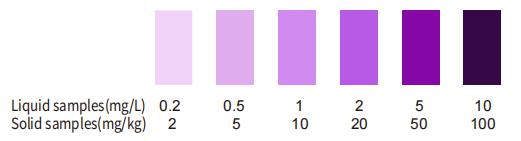
Place the color-developing tube of the sample horizontally on white paper, elevate of the top of tube, and compare it with the standard color card. The corresponding color on the color card can obtain the corresponding concentration range. In order to avoid false negative results as much as possible, when interpreting, if the color develops between two color blocks, take the intermediate value of the two concentrations.
User manual


