
SKU : GC303004-25g
Categories : Biochemicals , 1. Chemical and Reagents , Buffers , Servicebio ,
Brand : Servicebio
Share
Product Information
Product Name | Cat. No. | Spec. |
Riboflavin | GC303004-25g | 25 g |
Introduction
Vitamin B2, also known as riboflavin, is one of the B vitamins, slightly soluble in water, is stable when heated in neutral or acidic solutions. It is a component of flavinase cofactors in the body (flavinase plays the role of hydrogen transfer in biological REDOX). When lacking, it will affect the biological oxidation of the body and cause metabolic disorders. Its lesions are mostly manifested as the inflammation of mouth, eye and external genital parts, such as keratitis, cheilitis, glossotis, conjunctivitis and scrotitis, so this product can be used for the prevention and treatment of the above diseases. Vitamin B2 stores in the body are very limited and therefore should be provided daily by the diet. Two properties of vitamin B2 are the main reasons for its loss: (1) it can be destroyed by light; (2) It can be destroyed by heating in alkali solution.
Basic Attributes
Name | Riboflavin |
Synonym | Vitamin B2; Beflavin; Lactoflavin |
CAS | 83-88-5 |
Molecular formula | C17H20N4O6 |
Molecular mass | 376.4 |
Purity | 99% |
Appearance (character) | Orange-yellow powder |
Storage conditions | 2-8 |
Period of validity | 36 months |
Unit | Bottle |
Spec. | 25 g |
Pubchem CID | 493570 |
MDL No. | MFCD00005022 |
EC No. | 201-507-1 |
Related categories | Vitamin |
Solubility | 100 mg/mL in water |
Molecular Structural
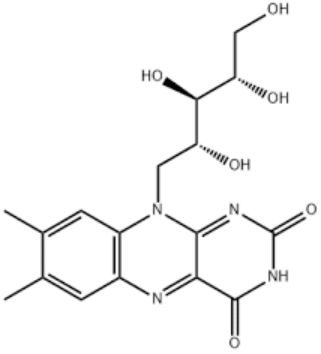
Instructions
The usage and dosage of biochemical reagents are mainly based on the customer's experimental purpose and the experimental methods in the existing literature or books, and the following uses are for reference only.
The biochemical reactions mainly involve the production of respiratory chain energy, the oxidation of amino acids and lipids, the conversion of purine bases to uric acid, the hydroxylation of aromatic compounds, the synthesis of proteins and certain hormones, the transport, storage and mobilization of iron, and the metabolism of folic acid, pyridoxal and nicotinic acid.
1. It participates in biological oxidation and energy metabolism in vivo, and is related to the metabolism of carbohydrate, protein, nucleic acid and fat. It can improve the utilization rate of protein by the body, promote growth and development, and maintain the integrity of skin and cell membrane. It has the function of protecting skin, hair follicle, mucous membrane and sebaceous gland.
2. It participates in the growth and metabolism of cells and is an essential nutrient for the metabolism and repair of body tissues, such as strengthening liver function and regulating the secretion of adrenaline.
3. It participates in the metabolism of vitamin B6 and nicotinic acid, and is a model of coordination of B vitamins. Fad and FMN are involved in the conversion of tryptophan to nicotinic acid and vitamin B6 to pyridoxal phosphate.
4. It is related to the absorption, storage and mobilization of body iron.
5. It also has antioxidant activity, which may be related to flavinase-glutathione reductase.
6. In photodynamic therapy, riboflavin can be used as a photosensitizer to treat tumors. 50 μmol/L riboflavin, 10.8 J/cm2 UV can effectively cause HCT116 tumor cells to lose their proliferative ability in peripheral blood.
Note:
Excessive intake may cause pruritus, paralysis, nosebleed, burning sensation, tingling, etc. If you are taking anticancer drugs, such as methotrexate, excessive B2 will reduce the effectiveness of these anticancer agents.
Food processing and cooking methods have a great impact on the absorption of vitamin B2. The biggest enemy of vitamin B2 is light, especially ultraviolet light. If milk is bottled in glass, the vitamin B2 in milk will be reduced to almost zero during one day. Another enemy of vitamin B2 is alkaline substance. Some people add alkali when cooking vegetables to keep them green. This method can completely destroy all vitamin B2 in vegetables. In addition, it is necessary to avoid water. Vitamin B2 can be lost with water. For example, vitamin B2 can only be retained in rice.
Security Information
Warning statement | 0 |
RTECS | VJ1400000 |
WGK | 1 |
Note: The product may be optimized and upgraded. The actual label information prevails.
For Research Use Only!


