
SKU : GC303001-5g
Categories : Biochemicals , 1. Chemical and Reagents , Buffers , Servicebio ,
Brand : Servicebio
Share
Product Information
Product Name | Cat. No. | Spec. |
Folic Acid | GC303001-5g | 5 g |
Introduction
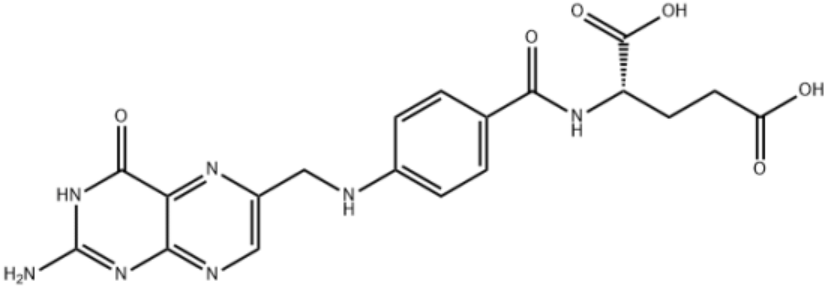
Folic acid is a water-soluble vitamin with the molecular formula C19H19N7O6. Because the content of green leaves is very rich and named, also known as Pteroylglutamic acid. It exists in several forms in nature, and its parent compound is composed of pteridine, p-aminobenzoic acid and glutamic acid.
Folic acid contains one or more glutamyl groups, and most naturally occurring folic acid is polyglutamatergic. The bioactive form of folic acid is tetrahydrofolate. Folic acid is yellow crystalline and slightly soluble in water, but its sodium salts are highly soluble in water,insoluble in ethanol. It is easy to destroy in acidic solution, unstable to heat, easy to lose at room temperature, and easy to be destroyed by light.
Folic acid, a derivative of pteridine, was originally isolated from the liver and later found to be abundant in the green leaves of plants, hence its name. It is widely found in meat, fresh fruits, vegetables, yellow crystalline powder, tasteless and odorless, its sodium salt is easily soluble in water, insoluble in alcohol and ethyl ether and other organic solvents, insoluble in cold water but slightly soluble in hot water. It is unstable in acidic solutions and easily destroyed by light.
Basic Attributes
Name | Folic acid |
Synonym | Vitamin m; N-4 - (2-amino-4-oxo-1,4-dihydro-6-piperidine) methylaminobenzoyl-l-glutamate; Amyl monoglutamic acid; Vitamin B9 |
CAS | 59-30-3 |
Molecular formula | C19H19N7O6 |
Molecular mass | 441.4 |
Purity | Approx.98% |
Appearance (character) | Yellow powder |
Storage conditions | 2-8 |
Unit | Bottle |
Spec. | 5 g |
Pubchem CID | 0 |
MDL No. | MFCD00079305 |
EC No. | 200-419-0 |
Related categories | Biochemical reagents, vitamins |
Solubility | 50mg/ml 1M NaOH |
Molecular Structural
Instructions
(1) Application of folic acid in pigs
The results showed that the supplementation of 2.5 mg/kg folic acid significantly increased the whole period daily gain of piglets compared with the basal diet group, and the serum protein concentration, liver DNA, RNA and protein contents were significantly increased, and the serum urea nitrogen concentration was significantly decreased. At the same time, it is also concluded that the higher level of folic acid supplementation dose reduces the growth performance of piglets.
Some researchers have found that folic acid supplementation has no significant effect on reproductive performance of primiparous sows, but significantly increases serum folic acid content in primiparous sows and newborn piglets. As an important cofactor in one-carbon unit metabolism, folic acid can reduce plasma homocysteine content and thus improve lipid peroxidation. Proteomic analysis showed that folic acid had significant effects on the expression and activity of antioxidant enzymes in rat liver.
(2) Application of folic acid in dairy cattle
There are few studies on folic acid in ruminants. It is generally believed that rumen microorganisms of ruminants can synthesize folic acid and make good use of it. However, some studies believe that multiparous cows require a large amount of folic acid during pregnancy and still need to add it from the diet. In the tissue metabolism of high-yield dairy cattle, folic acid and choline can provide a carbon group for the body tissue of dairy cattle, which is used for energy and protein metabolism, purine and DNA synthesis, so as to improve the production performance of dairy cattle.
(3) Application of folic acid in chicken breeding
Some researchers added 1.64, 2.14 and 2.64 mg/kg folic acid to the diet of broats, and the results showed that 1.64 mg/kg folic acid significantly increased the feed intake and average daily gain of broats, and significantly increased the content of fructosamine in serum. 2.64mg/kg water supplementation significantly increased the serum uric acid content of broilers; Folic acid supplementation can significantly increase the serum protein content of broilers at 21 days of age, and 3.0mg/kg supplemental level can significantly increase the feed intake and average daily gain of broilers, and significantly reduce the ratio of feed to gain. It is found that folic acid combined with niacin can significantly increase the average daily gain of broilers. Other studies have suggested niacin and folic acid combination can significantly reduce the abdominal fat weight and abdominal fat rate, improve chest muscle weight, leg muscle and leg muscle rate, and can significantly increase the thymus index and spleen index of broiler chickens and bursa of fabricius index, also can to a certain extent, improve the content of serum immunoglobulin, significantly reduce serum cholesterol levels, It can also improve the apparent digestibility of dry matter, crude protein, crude fat, crude fiber, organic matter and nitrogen free extract.
Note:
Human gut bacteria synthesize folic acid, so they are generally not susceptible to deficiency. Folate deficiency can occur when malabsorption, metabolic disorders, or long-term use of intestinal antibacterials. In addition, folic acid is also widely found in animal and plant foods, rich in: offal, eggs, fish, pears, broad beans, beets, spinach, cauliflower, celery, lettuce, citrus, nuts and legumes. When the daily intake of folic acid is maintained at 3.1μg/kg per day, the body can have appropriate folic acid reserve. Pregnant women should consume more than 350μg of folic acid per day. The safe intake of infants by kg scale is similar to that of adults, that is, 3.6μg/kg daily can meet the needs of growth and maintenance of normal blood image.
Security Information
Warning statement | P261-P305+P351+P338 |
RTECS | LP5425000 |
WGK | 1 |
Note: The product may be optimized and upgraded. The actual label information prevails.
For Research Use Only!


