SKU :
Option name 1
Categories : 3. Protein & Enzyme , Recombinant protein , Servicebio ,
Brand : Servicebio
Share
DESCRIPTION | ||
Gene Name Synonym | LIF, CDF, DIA, HILDA, MLPLI | |
Species | Human | |
Accession | P15018 | |
Source | HEK293 cells | |
SPECIFICATIONS | ||
Amino acid sequence | Ser23-Phe202 is expressed with a 10×His tag at the N terminus | |
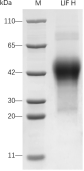
Molecular Weight | 21.2 kDa(The protein migrates as 35-55 kDa under reducing condition (SDS-PAGE) due to glycosylation) | |
Purity | >95.0% as determined by SDS-PAGE | |
Endotoxin | <5 EU mg-1 | |
Formulation | Lyophilized from sterile PBS, pH 7.4.Normally 5%-8% trehalose and mannitol are added as protectants before lyophilization. | |
Reconstitution | Dissolved in sterile water, it is recommended to add 0.1% HSA or BSA for long-term preservation. | |
STORAGE | ||
Stability and Storage | 12 months from date of receipt at -20°C to -70°C. After reconstitution, it is stable at 4°C for 1 week or -20°C for almost 6 months (with carrier protein). It is recommended to freeze aliquots at -20°C or -80°C for extended storage. | |
BACKGROUND | ||
Leukemia inhibitory factor (LIF) is the most pleiotropic member of the interleukin-6 family of cytokines. It utilises a receptor that consists of the LIF receptor β and gp130 and this receptor complex is also used by ciliary neurotrophic growth factor (CNTF), oncostatin M, cardiotrophin1 (CT1) and cardiotrophin-like cytokine (CLC). This leads to the activation of the JAK/STAT and MAPK cascades. LIF does appear to have non-redundant actions in maternal receptivity to blastocyst implantation, placental formation and in the development of the nervous system. LIF is involved in growth promotion and cell differentiation of different types of target cells, influence bone metabolism, cachexia, neural development, embryogenesis, and inflammation. LIF is involved in the pathogenic events and development of many diseases of various origins. | ||
Data | ||
SDS-PAGE | Bioactivity | |
| Testing in progress | |
Recombinant Human LIF Protein was determined by SDS-PAGE with Coomassie Blue, showing a band at 35-50 kDa. | ||
For Research Use Only!
Ver. No.: V1.0-202102