SKU :
Option name 1
Categories : 3. Protein & Enzyme , Recombinant protein , Servicebio ,
Brand : Servicebio
Share
DESCRIPTION | ||
Gene Name Synonym | IGF-I, IGF1A, somatomedin C, MGF | |
Species | Human | |
Accession | P49764 | |
Source | HEK293 cells | |
SPECIFICATIONS | ||
Amino acid sequence | Gly49-Ala118 is expressed with a 10×His tag at the C terminus | |
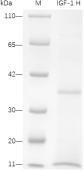
Molecular Weight | 9.1 kDa | |
Purity | >95.0% as determined by SDS-PAGE | |
Endotoxin | <5 EU mg-1 | |
Formulation | Lyophilized from sterile PBS, pH 7.4.Normally 5%-8% trehalose and mannitol are added as protectants before lyophilization. | |
Reconstitution | Dissolved in sterile water, it is recommended to add 0.1% HSA or BSA for long-term preservation. | |
STORAGE | ||
Stability and Storage | 12 months from date of receipt at -20°C to -70°C. After reconstitution, it is stable at 4°C for 1 week or -20°C for almost 6 months (with carrier protein). It is recommended to freeze aliquots at -20°C or -80°C for extended storage. | |
BACKGROUND | ||
Insulin-like growth factor 1 (IGF-1) is also known as somatomedin C, IGF1A, IGFI, sulfation factor, and is a hormone similar in molecular structure to insulin. It plays an important role in childhood growth and continues to have anabolic effects in adults. A synthetic analog of IGF-1, mecasermin is used for the treatment of growth failure. IGF-1 consists of 70 amino acids in a single chain with three intramolecular disulfide bridges. IGF-1 has a molecular weight of 7649 daltons. IGF-1 is produced primarily by the liver as an endocrine hormone as well as in target tissues in a paracrine/autocrine fashion. IGF-1 binds to at least two cell surface receptors: the Insulin-like growth factor 1 receptor, abbreviated as "IGF1R", and the insulin receptor. The IGF-1 receptor seems to be the "physiologic" receptor - it binds IGF-1 at significantly higher affinity than the IGF-1 that is bound to the insulin receptor. Like the insulin receptor, the IGF-1 receptor is a receptor tyrosine kinase - meaning it signals by causing the addition of a phosphate molecule on particular tyrosines. Its primary action is mediated by binding to its specific receptor IGF1R, present on many cell types in many tissues. Binding to the IGF1R, a receptor tyrosine kinase, initiates intracellular signaling; IGF-1 is one of the most potent natural activators of the AKT signaling pathway, a stimulator of cell growth and proliferation, and a potent inhibitor of programmed cell death. | ||
Data | ||
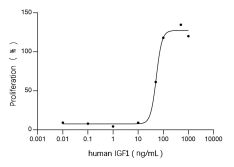
SDS-PAGE | Bioactivity | |
|
| |
Active Recombinant Human IGF1 Protein was determined by SDS-PAGE with Coomassie Blue. | Measured in a cell proliferation assay using PDC-P1 cells. The ED50 for this effect is 0.05-0.1 μg/mL. | |