SKU :
Option name 1
Categories : 3. Protein & Enzyme , Recombinant protein , Servicebio ,
Brand : Servicebio
Share
DESCRIPTION | ||
Gene Name Synonym | C-C motif chemokine 2; MCP-1; Platelet-derived growth factor-inducible protein JE; Small-inducible cytokine A2; Ccl2; Je;Mcp1; Scya2 | |
Species | Rat | |
Accession | P14844 | |
Source | HEK293 cells | |
SPECIFICATIONS | ||
Amino acid sequence | Gln24-Asn148 is expressed with a 10×His tag at the C terminus | |
Molecular Weight | 14.1 kDa | |
Purity | >95.0% as determined by SDS-PAGE | |
Endotoxin | <5 EU mg-1 | |
Formulation | Lyophilized from sterile PBS, pH 7.4.Normally 5%-8% trehalose and mannitol are added as protectants before lyophilization. | |
Reconstitution | Dissolved in sterile water, it is recommended to add 0.1% HSA or BSA for long-term preservation. | |
STORAGE | ||
Stability and Storage | 12 months from date of receipt at -20°C to -70°C. After reconstitution, it is stable at 4°C for 1 week or -20°C for almost 6 months (with carrier protein). It is recommended to freeze aliquots at -20°C or -80°C for extended storage. | |
BACKGROUND | ||
Monocyte chemoattractant protein 1 (MCP-1), also called CCL2, belongs to a group of CC chemokines located in chromosome 17q11.2. MCP-1 protein interacts with chemokine C-C motif receptor 2 (CCR2) to activate and recruit monocytes, macrophages, CD4+ T cells and immature dendritic cells to the site of infection. In addition to itschemotactic activity, CCL2 induces enzyme and cytokine release by monocytes, NK cells and lymphocytes, andhistamine release by basophils that express its receptor, CCR2. Additionally, it promotes Th2 polarization inCD4+ T cells. CCL2-mediated recruitment of monocytes to sites of inflammation is proposed to play a role inthe pathology of atherosclerosis, multiple sclerosis and allergic asthma. | ||
Data | ||
SDS-PAGE | Bioactivity | |
|
| |
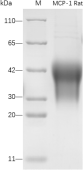
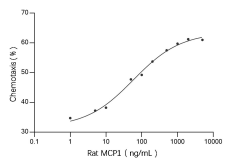
Active Recombinant Rat MCP1 Protein was determined by SDS-PAGE with Coomassie Blue, showing a band at 30-40 kDa. | Fully biologically active determined by the dose dependent migration of THP-1 monocytes, The ED50 for this effect is typically 58 ng/mL. | |