SKU :
Option name 1
Categories : 3. Protein & Enzyme , Recombinant protein , Servicebio ,
Brand : Servicebio
Share
DESCRIPTION | ||
Gene Name Synonym | FSP, GRO1, GROa, MGSA, MGSA-a, NAP-3, SCYB1, CXCL1 | |
Species | Mouse | |
Accession | P12850 | |
Source | HEK293 cells | |
SPECIFICATIONS | ||
Amino acid sequence | Ala25-Lys96 is expressed with a 10×His tag at the C terminus | |
Molecular Weight | 7.8 kDa | |
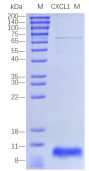
Purity | >95.0% as determined by SDS-PAGE | |
Endotoxin | <5 EU mg-1 | |
Formulation | Lyophilized from sterile PBS, pH 7.4.Normally 5%-8% trehalose and mannitol are added as protectants before lyophilization. | |
Reconstitution | Dissolved in sterile water, it is recommended to add 0.1% HSA or BSA for long-term preservation. | |
STORAGE | ||
Stability and Storage | 12 months from date of receipt at -20°C to -70°C. After reconstitution, it is stable at 4°C for 1 week or -20°C for almost 6 months (with carrier protein). It is recommended to freeze aliquots at -20°C or -80°C for extended storage. | |
BACKGROUND | ||
Chemokine (C-X-C motif) ligand 1 (CXCL1) is a small molecule of cytokines belonging to the CXC chemokine family. Also known as growth-regulated oncogene alpha (Growth-regulated oncogene alpha, GROα). Its also known as keratinocytes-derived chemokine (KC) in mice or cytokine-induced neutrophil chemoattractant type-1 (CINC-1) in rats. In humans, this protein is encoded by the gene Cxcl1 and is located on human chromosome 4 among genes for other CXC chemokines. The chemokine CXCL1 is expressed by macrophages, neutrophils and epithelial cells. The chemokine CXCL1 has a chemotactic effect on neutrophils. CXCL1 binds to the chemokine receptor CXCR2 and plays a role in cell chemotaxis. Human CXCL1 is clustered on chromosome 4 adjacent to many CXC chemokine genes. Major roles of CXCL1 include neovascularization, inflammation, wound healing, and tumorigenesis. | ||
Data | ||
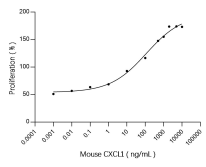
SDS-PAGE | Bioactivity | |
|
| |
Recombinant Mouse CXCL1 Protein was determined by SDS-PAGE with Coomassie Blue. | Measured in a cell proliferation assay using human umbilical vein endothelial cells. The ED50 for this effect is 50-100 ng/mL. | |