SKU :
Option name 1
Categories : 3. Protein & Enzyme , Recombinant protein , Servicebio ,
Brand : Servicebio
Share
DESCRIPTION | ||
Gene Name Synonym | FGF-1, FGF1, ECGF, HBGF-1, FGFA, aFGF | |
Species | Human | |
Accession | P05230 | |
Source | E.coli | |
SPECIFICATIONS | ||
Amino acid sequence | E.coli-derived Human aFGF protein, Phe16-Asp155. | |
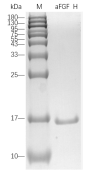
Molecular Weight | Approximately 16.0 kDa. | |
Purity | >97.0% as determined by SDS-PAGE. | |
Endotoxin | <1.0 EU/μg of the protein by the LAL method. | |
Formulation | Lyophilized from sterile Tris-Hcl, pH 8.0. Normally 5%-8% trehalose and mannitol are added as protectants before lyophilization. | |
Reconstitution | Dissolved in sterile water, it is recommended to add 0.1% HSA or BSA for long-term preservation. | |
STORAGE | ||
Stability and Storage | 12 months from date of receipt at -20°C to -70°C. After reconstitution, it is stable at 4°C for 1 week or -20°C for almost 6 months (with carrier protein). It is recommended to freeze aliquots at -20°C or -80°C for extended storage. | |
BACKGROUND | ||
Data | ||
SDS-PAGE | Bioactivity | |
|
| |
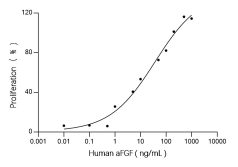
Recombinant Human aFGF Protein was determined by SDS-PAGE with Coomassie Blue. | Measured in a cell proliferation assay using Balb/C 3T3 A31 mouse embryonic fibroblast cells. The ED50 for this effect is 0.01-0.05 μg/mL. | |